


By John Okandi Kogada – Project Manager and Senior Technical Advisor and Anne Gitimu – Programme Director, Reproductive, Maternal, Newborn, Child and Adolescent Health (Amref Health Africa in Kenya)
Violence against
women and girls remains a huge global problem that impacts the day-to-day lives
of millions of girls and women each year. There are several justifications and
drivers for Gender-Based Violence (GBV) and harmful cultural practices, but
frequently, these are based on gender norms (social norms) and unequal power. This
violence continues to happen in communities that justify the practice in a very
noble manner, many times believing it is for the good of the girls, their
families or a safeguard to their traditions. This often makes it a difficult
practice to challenge.
In the last
several decades, efforts to reduce GBV have gained traction with governments,
international agencies, donors and civil society organisations setting legal,
institutional and policy environments to support ending GBV. GBV prevention
interventions have focused on economic empowerment, legislation and policy
development, legal protection and rights awareness creation.
However, social
norm change toward zero gender violence and elimination of harmful cultural
practices requires more than supportive attitudes and awareness creation. These
efforts must include an intentional move to tackle the entrenched social norms
that place women and girls in the path of harm and discrimination. But most centrally,
we must seek to support change from within the communities where these women
and girls live. Conversations about the role of communities should be galvanized
around rethinking gender norms that promote violence against women.
An emerging body
of evidence indicates that in addition to traditional interventions, there is
need to develop initiatives that target the transformation of social norms that
ground and justify the promotion of GBV. However, challenging gender norms that
communities view as cultural assets evokes two emotions: the feeling that you
want them to abandon what they know and believe to be correct (antagonising long
held realities); and, introducing new and contradicting behaviour (eliciting
and building new fears). A powerful way to help communities overcome these
suspicions and fear is to engage them in open, guided and structured community
conversations. Over the past two years, our work has proven that community
dialogues trigger community support for collective change and act as an
effective approach to address deeply rooted gender norms that continually see
women as subordinates and justify the violence meted on them.
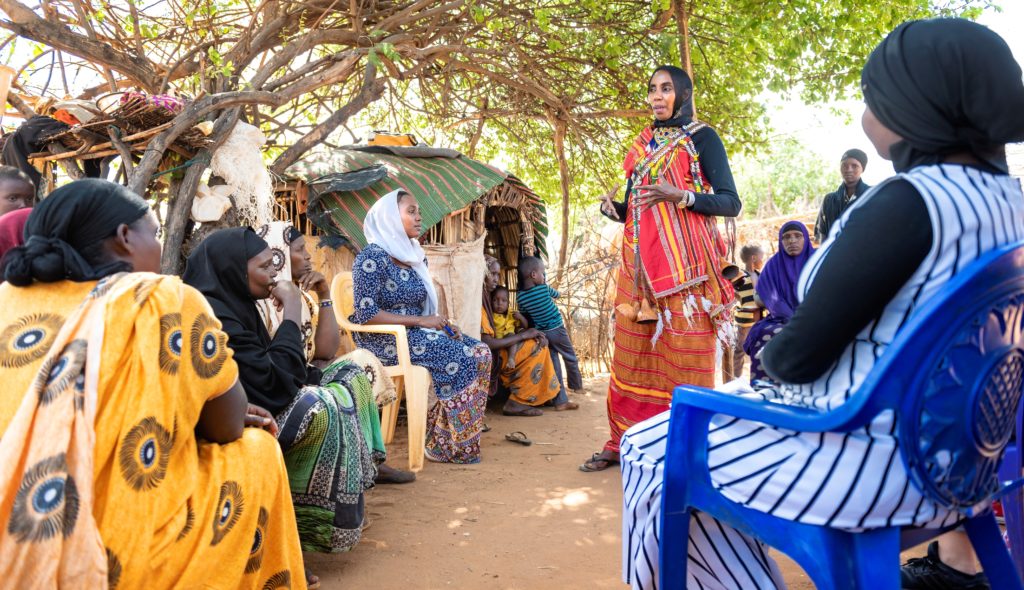
Community
dialogues provide an interactive participatory communication process that allows
for information sharing, consensus building, reflective thinking, interrogation
of assumptions, and group visioning. Community dialogues are based on the
principles of respect for the community’s abilities to identify its needs and
address its own problems; seeking local knowledge and solutions; recognising diversity;
and empowerment of communities to make own decisions. Dialogues around social
norms are challenging, but the collective learnings drawn from this process
inform the collective efforts necessary to achieve attitude and norm change. Community
conversations allow for small steps in collective decision making that leads to
a shift in behaviour.
Social norms
modify and reinforce behaviour yet they are considerably fragile and can
collapse, creating shifts in behaviour when norms are defied and set on a
declining path. However, this can also entrench the norms hence the need to
engage communities in structured dialogues towards eventual small steps that
can be cascaded throughout the community. These shifts allow for the formation
of new preferences and ideas. To achieve these shifts, community dialogues must
be facilitated not by outsiders, but by community members who serve as community
champions.
Community
dialogues provide both formal and informal channels to discuss new ideas and
expose communities to new practices to which they respond by either contesting
and/or resisting this change. Engaging respectfully with decision making
structures from the point of entry however makes all the difference. While this
may not achieve a total nod, it minimizes resistance and builds a pool of
supporters who will sustain the change agenda. New ideas, knowledge and
practices are typically spread through continuous communication with the
communities and provide an avenue for collective action and social evolution
towards accelerated norm change.
Structured
community dialogues are designed to normalise discussion around culturally
sensitive issues and especially around gender norms that restrict and diminish
the advancement of women and girls. This offers a platform for both communities
and change agents to discuss issues and gather community suggestions and
participation, addressing them respectfully. The long term benefits of community conversations are
community involvement, ownership, sustainability and achievement of desired attitude
and behaviour changes.
As Nairobi
prepares to host the International Conference on Population and Development
(ICPD) in November, there is an opportunity for the country to accelerate its
efforts to end gender-based violence and harmful practices. Participants at the
conference will look into what has worked towards ending the threat of violence
and harm.
Our take is that unless we transform our social norms; we cannot achieve zero gender violence.

so welcoming,
easy to understand